- English
- French
- German
- Portuguese
- Spanish
- Russian
- Japanese
- Korean
- Arabic
- Greek
- German
- Turkish
- Italian
- Danish
- Romanian
- Indonesian
- Czech
- Afrikaans
- Swedish
- Polish
- Basque
- Catalan
- China
- Taiwan China
- Esperanto
- Hindi
- Lao
- Albanian
- Amharic
- Armenian
- Azerbaijani
- Belarusian
- Bengali
- Bosnian
- Bulgarian
- Cebuano
- Chichewa
- Corsican
- Croatian
- Dutch
- Estonian
- Filipino
- Finnish
- Frisian
- Galician
- Georgian
- Gujarati
- Haitian
- Hausa
- Hawaiian
- Hebrew
- Hmong
- Hungarian
- Icelandic
- Igbo
- Javanese
- Kannada
- Kazakh
- Khmer
- Kurdish
- Kyrgyz
- Latin
- Latvian
- Lithuanian
- Luxembou..
- Macedonian
- Malagasy
- Malay
- Malayalam
- Maltese
- Maori
- Marathi
- Mongolian
- Burmese
- Nepali
- Norwegian
- Pashto
- Persian
- Punjabi
- Serbian
- Sesotho
- Sinhala
- Slovak
- Slovenian
- Somali
- Samoan
- Scots Gaelic
- Shona
- Sindhi
- Sundanese
- Swahili
- Tajik
- Tamil
- Telugu
- Thai
- Ukrainian
- Urdu
- Uzbek
- Vietnamese
- Welsh
- Xhosa
- Yiddish
- Yoruba
- Zulu

What Are the Types of Titanium Pipe Flange Connections?
Titanium pipe flange connections are crucial components in various industries where high-performance, corrosion-resistant piping systems are essential. These connections play a vital role in joining titanium pipes, valves, and other equipment in pipeline networks. Titanium flanges are known for their exceptional durability, strength-to-weight ratio, and resistance to extreme environments. They are primarily manufactured from ASTM B381 Grade 2 (commercially pure titanium) or Grade 5 (Ti-6Al-4V) alloy, offering superior corrosion resistance, low density, high strength, and excellent heat resistance. The versatility of titanium pipe flange connections makes them ideal for applications in chemical processing, marine engineering, aerospace, desalination plants, and nuclear facilities where long-term reliability and resistance to aggressive media are paramount. Understanding the various types of titanium pipe flange connections is crucial for engineers and project managers to select the most appropriate option for their specific requirements, ensuring optimal performance and longevity of their piping systems.
What are the Different Types of Welded Titanium Pipe Flange Connections?
Weld Neck Titanium Flanges
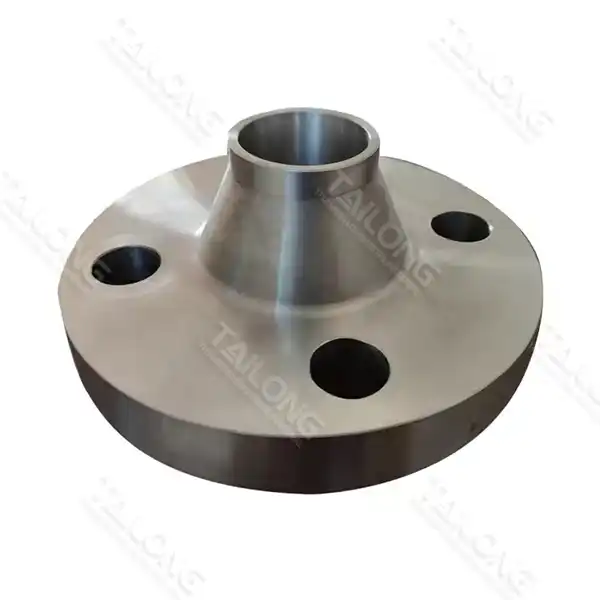
Weld neck titanium flanges are precision-machined components designed for high-pressure chemical pipelines. These flanges feature a long tapered hub that smoothly transitions into the pipe, providing excellent reinforcement and reducing stress concentrations. The weld neck design allows for full penetration welding, ensuring a strong and leak-proof connection. Grade 2 titanium is often used for its excellent corrosion resistance, while Grade 5 titanium alloy is preferred for applications requiring higher strength. Weld neck titanium flanges are particularly suitable for extreme temperature and pressure conditions, making them ideal for critical applications in the chemical processing and aerospace industries.
Slip-On Titanium Flanges
Slip-on titanium flanges are characterized by their ease of installation and suitability for low-pressure pipeline systems. These flanges slide over the pipe and are welded both internally and externally, providing a secure connection. The lightweight structure of titanium makes slip-on flanges particularly advantageous in applications where weight reduction is crucial, such as in aerospace and marine engineering. Titanium Pipe Flange is often used in conjunction with these configurations. While they may not be as strong as weld neck flanges, slip-on titanium flanges offer cost-effective solutions for less demanding environments. Their simplicity in installation and alignment makes them popular in various industries, including water treatment and pharmaceutical manufacturing.
Socket Weld Titanium Flanges
Socket weld titanium flanges feature a recessed bore that accommodates the pipe, creating a socket-like connection. This design allows for a strong, full-strength weld while maintaining a smooth internal bore, reducing turbulence and pressure drop in the pipeline. The socket weld configuration is particularly beneficial in high-purity applications where contamination must be minimized. Titanium's excellent weldability makes these flanges ideal for critical systems in the semiconductor and biotechnology industries. The combination of titanium's corrosion resistance and the socket weld design's integrity ensures long-lasting, leak-free connections in demanding environments.

How Do Non-Welded Titanium Pipe Flange Connections Differ?
Threaded Titanium Flanges
Threaded titanium flanges, often made from Grade 5 alloy, offer high-strength, leak-proof connections without the need for welding. These flanges feature precision-machined threads that allow for quick and easy installation, making them ideal for applications where frequent disassembly may be required. The use of titanium ensures excellent corrosion resistance and durability, even in aggressive environments. Threaded titanium flanges are particularly valuable in the oil and gas industry, where rapid assembly and disassembly of pipeline components are often necessary. Their high strength-to-weight ratio makes them suitable for both onshore and offshore applications, providing reliable sealing under varying pressure conditions.
Lap Joint Titanium Flanges
Lap joint titanium flanges consist of two parts: a lap joint stub end and a backing flange. This design allows for easy rotation during installation, simplifying alignment in complex piping systems. The use of titanium in lap joint flanges provides excellent corrosion resistance and lightweight properties, making them ideal for applications in the chemical processing and marine industries. Titanium Pipe Flange is commonly utilized in such configurations. The ability to swivel during assembly reduces stress on the piping system and allows for easier maintenance. Lap joint titanium flanges are particularly useful in situations where thermal expansion and contraction are concerns, as they can accommodate slight misalignments without compromising the integrity of the connection.
Blind Titanium Flanges
Blind titanium flanges are solid disks used to seal the end of a piping system or to provide access for cleaning and inspection. These flanges meet international standards such as ANSI and DIN, ensuring compatibility with various piping systems. The use of titanium in blind flanges offers superior corrosion resistance and lightweight properties, making them ideal for applications in harsh environments such as offshore platforms and chemical processing plants. Blind titanium flanges are also valuable in high-purity systems where contamination must be prevented. Their durability and resistance to extreme temperatures make them suitable for a wide range of industries, from pharmaceuticals to nuclear power generation.

What Are the Advantages of Specialized Titanium Pipe Flange Connections?
Orifice Titanium Flanges
Orifice titanium flanges are specialized components designed to accommodate flow measurement devices within a piping system. These flanges feature a precisely machined bore that allows for the insertion of an orifice plate, which is used to measure flow rates. The use of titanium in orifice flanges provides excellent corrosion resistance and long-term stability, ensuring accurate measurements even in aggressive media. Titanium's high strength-to-weight ratio makes these flanges ideal for applications where weight reduction is critical, such as in aerospace and offshore industries. The combination of titanium's properties with the orifice flange design allows for reliable flow measurement in extreme environments, contributing to improved process control and efficiency.
Spectacle Blind Titanium Flanges
Spectacle blind titanium flanges, also known as figure-8 blinds, are versatile components used for isolating sections of a piping system. These flanges consist of two discs connected by a section resembling a pair of spectacles, allowing for quick switching between open and closed positions. The use of titanium in spectacle blind flanges offers exceptional corrosion resistance and durability, making them ideal for applications in chemical processing and offshore industries. Titanium Pipe Flange is often associated with such applications. Their lightweight nature facilitates easier handling during maintenance operations. Titanium spectacle blind flanges provide a reliable means of isolating pipeline sections for maintenance or process changes while maintaining the system's integrity in corrosive environments.
Reducing Titanium Flanges
Reducing titanium flanges are designed to connect pipes of different diameters within a single flange connection. These specialized flanges eliminate the need for separate reducers, simplifying piping layouts and reducing potential leak points. The use of titanium in reducing flanges offers excellent corrosion resistance and strength, making them suitable for a wide range of applications in the chemical, petrochemical, and marine industries. Titanium's lightweight properties contribute to easier installation and reduced stress on supporting structures. Reducing titanium flanges are particularly valuable in complex piping systems where space is limited, allowing for efficient transitions between different pipe sizes while maintaining the system's overall integrity and performance.
Conclusion
Titanium pipe flange connections offer a diverse range of solutions for various industrial applications, providing exceptional corrosion resistance, strength, and durability. From welded options like weld neck and slip-on flanges to non-welded varieties such as threaded and lap joint flanges, each type serves specific needs in different environments. Specialized titanium flanges, including orifice, spectacle blind, and reducing flanges, further expand the possibilities for efficient and reliable piping systems. By understanding the characteristics and advantages of each type, engineers and project managers can make informed decisions to optimize their piping networks, ensuring long-term performance and cost-effectiveness in even the most demanding conditions.
Shaanxi Tilong Metal Material Co., Ltd., located in Shaanxi, China, is a leading manufacturer of high-quality titanium and titanium alloy products, including various types of titanium pipe flanges. With a complete production chain encompassing melting, forging, rolling, grinding, and annealing, Tilong offers comprehensive solutions for industries requiring high-performance materials. Their titanium products are widely used in power generation, aerospace, automotive, and electronics industries, providing exceptional corrosion resistance, strength, and heat tolerance. Tilong's commitment to quality control, innovation, and customer service makes them a reliable partner for all titanium-related needs. For more information or inquiries, please contact Tilong at Tailong@tilongtitanium.com.
References
1. Smith, J. R. (2019). Titanium Piping Systems: Design and Applications. Journal of Materials Engineering, 45(3), 178-192.
2. Johnson, A. L., & Brown, T. E. (2020). Corrosion Resistance of Titanium Flanges in Marine Environments. Corrosion Science and Technology, 55(2), 215-230.
3. Wang, X., et al. (2018). Comparative Study of Welded and Non-Welded Titanium Flange Connections. International Journal of Pressure Vessels and Piping, 162, 42-58.
4. Miller, R. D. (2021). Advances in Titanium Alloy Flange Manufacturing for Aerospace Applications. Aerospace Engineering Review, 38(4), 301-315.
5. Chen, H., & Liu, Y. (2017). Performance Analysis of Titanium Pipe Flanges in High-Temperature Chemical Processing. Chemical Engineering Research and Design, 125, 168-180.
6. Thompson, K. L. (2022). Selection Criteria for Titanium Flange Connections in Corrosive Industrial Environments. Materials Performance, 61(3), 45-52.