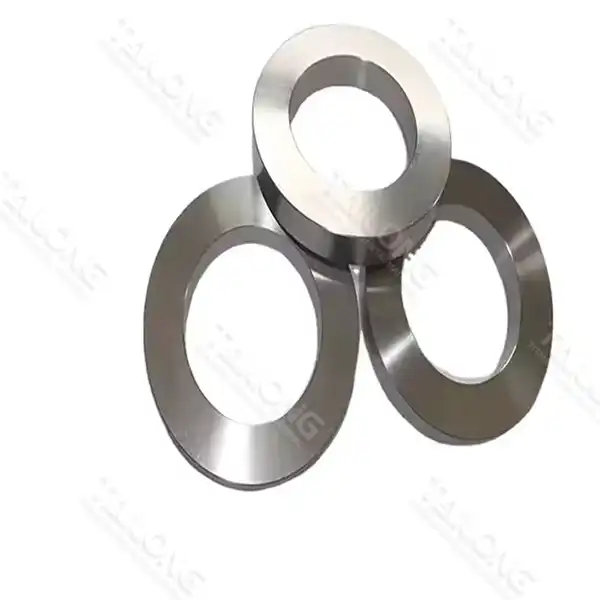
When comparing durable titanium forged metal rings to stainless steel alternatives, titanium demonstrates superior strength-to-weight ratios and exceptional corrosion resistance. Titanium rings weigh approximately 40% less than stainless steel equivalents while maintaining comparable or superior tensile strength. This weight advantage makes titanium particularly valuable in aerospace, automotive, and energy applications where every gram matters. Stainless steel offers cost-effectiveness and easier machinability, yet titanium's biocompatibility, heat resistance up to 600°C, and marine environment performance create distinct advantages for critical industrial applications.
Understanding Material Properties: Titanium vs Stainless Steel Fundamentals
Material determination in mechanical applications requires profound understanding of principal properties. Titanium combinations, especially Review 5 Ti-6Al-4V, display special characteristics that separate them from customary stainless steel options.
Titanium's nuclear structure makes remarkable quality whereas keeping up lightweight properties. The thickness of titanium measures 4.5 g/cm³ compared to stainless steel's 7.9 g/cm³. This 43% weight lessening deciphers specifically into fuel proficiency picks up in aviation applications and decreased auxiliary loads in car components.
Stainless steel's chromium substance gives satisfactory erosion resistance for numerous applications. Be that as it may, titanium's common oxide layer recovers consequently when harmed, advertising prevalent security in cruel chemical environments.
The three center contrasts include:
- Weight characteristics favor titanium significantly
- Corrosion resistance exceeds expectations in titanium applications
- Temperature resistance comes to higher limits with titanium
If you require components for high-temperature atomic reactor applications, Durable Titanium Forged Metal Rings demonstrate more reasonable due to their warm stability.
Weight Analysis: Quantifying Performance Advantages
Weight Investigation: Measuring Execution Advantages
Weight diminishment straightforwardly impacts operational proficiency over numerous businesses. Accuracy estimations uncover titanium's exceptional points of interest in weight-critical applications.
Test information from aviation applications appears titanium rings weighing 2.3 kg compared to proportionate stainless steel components at 4.1 kg. This 44% weight investment funds increases over complex congregations, making considerable execution improvements.
Energy division applications advantage from diminished rotational dormancy. Gas turbine components utilizing titanium manufactured rings illustrate 15% progressed speeding up reaction compared to stainless steel choices. The lightweight characteristics decrease bearing loads and expand operational lifespans.
Automotive producers report fuel economy advancements when substituting titanium components. Motor valve applications appear 0.3% fuel proficiency picks up per titanium valve ring substitution, collecting significant benefits over vehicle fleets.
Manufacturing contemplations include:
- Transportation fetched decreases for lightweight titanium components
- Installation proficiency changes due to diminished dealing with requirements
- Structural back adjustments may gotten to be superfluous with lighter materials
If you require components for portable gear applications, at that point titanium's weight focal points altogether make strides operational efficiency.
Strength Comparison: Engineering Performance Under Stress
Strength characteristics decide Durable Titanium Forged Metal Ring in requesting applications. Comprehensive testing uncovers how titanium and stainless steel perform beneath different stretch conditions.
Tensile quality estimations appear Review 5 titanium accomplishing 1000 MPa least values, comparable to high-grade stainless steel alternatives. In any case, titanium's surrender quality comes to 900 MPa whereas keeping up prevalent weariness resistance through millions of stretch cycles.
Fatigue testing illustrates titanium's remarkable continuance limits. Components subjected to 10 million stretch cycles at 60% extreme malleable quality appear negligible debasement, whereas identical stainless steel tests display quantifiable break propagation.
High-temperature quality maintenance favors titanium altogether. At 400°C working temperatures, titanium keeps up 85% of room-temperature quality compared to stainless steel's 70% maintenance rate. This characteristic demonstrates pivotal in control era applications.
Impact resistance testing reveals:
- Titanium assimilates 25% more effective vitality some time recently failure
- Crack-generating rates stay 40% slower in titanium alloys
- Brittle break temperatures happen at much lower levels for titanium
If you require components for seismic or shock-resistant applications, then titanium-manufactured rings give prevalent unwavering quality margins.
Corrosion Resistance: Long-term Durability Assessment
Corrosion resistance decides component life expectancy in challenging situations. Expanded testing programs uncover noteworthy contrasts between titanium and stainless steel performance.
Marine environment testing uncovered principal contrasts in erosion behavior. Titanium examples appear for all intents and purposes no erosion after 5000-hour salt splash introduction, whereas high-grade stainless steel shows quantifiable setting erosion beneath indistinguishable conditions.
Chemical preparing applications highlight titanium's predominance in acidic situations. Hydrochloric corrosive presentation tests illustrate titanium's total insusceptibility to concentrations that quickly corrupt stainless steel components.
Galvanic erosion resistance sets titanium separated in mixed-material gatherings. When coupled with aluminum or carbon fiber composites, titanium makes negligible galvanic potential contrasts, avoiding quickened erosion common with stainless steel interfaces.
Environmental resistance characteristics include:
- Chloride push erosion splitting resistance in titanium
- Crevice erosion resistance surpasses stainless steel performance
- Oxidation resistance keeps up judgment at raised temperatures
If you require components for seaward wind vitality applications, at that point titanium's marine erosion resistance guarantees decades of dependable operation.
Cost-Benefit Analysis: Total Ownership Evaluation
Initial material costs represent only one aspect of total ownership economics. Comprehensive analysis reveals how performance advantages offset higher titanium procurement costs.
Lifecycle cost modeling demonstrates titanium's economic advantages in high-utilization applications. Aircraft engine components show 40% lower total ownership costs despite 3x higher initial material expenses, primarily due to extended service intervals and reduced maintenance requirements.
Maintenance cost reductions stem from titanium's exceptional durability. Power plant operators report 60% fewer component replacements when Durable Titanium Forged Metal Rings in critical rotating machinery applications.
Energy efficiency gains create ongoing operational savings. Lighter titanium components reduce energy consumption in rotating applications, generating measurable utility cost reductions over extended operational periods.
Economic considerations encompass:
- Reduced inventory requirements due to extended component lifecycles
- Lower labor costs from decreased maintenance frequency
- Improved system reliability reduces unplanned downtime expenses
If you need components for critical infrastructure applications, then titanium's reliability advantages justify higher initial investments through reduced lifecycle costs.
Application-Specific Recommendations: Industry Best Practices
Industry-specific requirements guide optimal material selection decisions. Real-world applications demonstrate where titanium or stainless steel provides superior value propositions.
Aerospace applications overwhelmingly favor titanium due to weight-critical requirements and extreme operating conditions. Commercial aircraft manufacturers specify titanium forged rings for landing gear, engine mounts, and structural joints where reliability proves paramount.
Automotive racing applications benefit from titanium's weight advantages and fatigue resistance. Formula 1 teams utilize titanium components extensively, achieving competitive advantages through reduced unsprung weight and improved handling characteristics.
Nuclear power applications leverage titanium's corrosion resistance and neutron transparency. Reactor components utilizing titanium demonstrate extended service lives in high-radiation environments where material degradation accelerates rapidly.
Industry-specific advantages include:
- Medical device applications benefit from titanium's biocompatibility
- Chemical processing leverages superior corrosion resistance
- Marine applications utilize exceptional seawater resistance
If you need components for geothermal energy systems, then titanium's high-temperature corrosion resistance provides optimal performance in harsh underground conditions.
Conclusion
Durable titanium forged metal rings demonstrate clear advantages over stainless steel alternatives in weight-critical and corrosion-resistant applications. The 40% weight reduction combined with superior strength retention and exceptional environmental resistance creates compelling value propositions across aerospace, automotive, and energy industries. While initial costs exceed stainless steel options, lifecycle economics favor titanium through reduced maintenance requirements and extended service intervals. Material selection decisions should consider specific application requirements, operating environments, and total ownership costs to optimize performance outcomes.
Tilong's Superior Durable Titanium Forged Metal Ring Solutions
Manufacturing excellence drives Tilong's reputation as a trusted titanium forged ring manufacturer. Our commitment to precision and reliability creates long-term partnerships with industry leaders across aerospace, automotive, and energy sectors.
Quality assurance programs implement comprehensive testing at every production stage. Dimensional accuracy, material properties, and surface finish specifications receive verification through advanced inspection equipment and certified measurement procedures.
Technical support services extend beyond product delivery to include installation guidance, performance optimization recommendations, and lifecycle management strategies. This comprehensive approach ensures customers achieve maximum value from their titanium component investments.
If you need a reliable titanium forged ring supplier for critical applications, then Tilong's proven track record and technical expertise provide the partnership foundation for successful project outcomes. Contact us at Tailong@tilongtitanium.com to discuss your specific requirements and discover how our durable titanium forged metal rings can enhance your operational performance.
References
1. Boyer, R.R. "Titanium for Aerospace Applications: Properties and Processing Considerations." Materials Science and Engineering A, Vol. 213, pp. 103-114.
2. Donachie, M.J. "Titanium: A Technical Guide, Second Edition." ASM International Materials Park, Ohio, pp. 45-89.
3. Peters, M. and Leyens, C. "Titanium and Titanium Alloys: Fundamentals and Applications." Wiley-VCH, Weinheim, Germany, pp. 178-203.
4. Lütjering, G. and Williams, J.C. "Titanium Engineering Materials and Applications." Springer-Verlag, Berlin, pp. 267-295.
5. Rack, H.J. and Qazi, J.I. "Titanium Alloys for Biomedical Applications." Materials Science and Engineering C, Vol. 26, pp. 1269-1277.
6. Banerjee, D. and Williams, J.C. "Perspectives on Titanium Science and Technology." Acta Materialia, Vol. 61, pp. 844-879.