- English
- French
- German
- Portuguese
- Spanish
- Russian
- Japanese
- Korean
- Arabic
- Greek
- German
- Turkish
- Italian
- Danish
- Romanian
- Indonesian
- Czech
- Afrikaans
- Swedish
- Polish
- Basque
- Catalan
- China
- Taiwan China
- Esperanto
- Hindi
- Lao
- Albanian
- Amharic
- Armenian
- Azerbaijani
- Belarusian
- Bengali
- Bosnian
- Bulgarian
- Cebuano
- Chichewa
- Corsican
- Croatian
- Dutch
- Estonian
- Filipino
- Finnish
- Frisian
- Galician
- Georgian
- Gujarati
- Haitian
- Hausa
- Hawaiian
- Hebrew
- Hmong
- Hungarian
- Icelandic
- Igbo
- Javanese
- Kannada
- Kazakh
- Khmer
- Kurdish
- Kyrgyz
- Latin
- Latvian
- Lithuanian
- Luxembou..
- Macedonian
- Malagasy
- Malay
- Malayalam
- Maltese
- Maori
- Marathi
- Mongolian
- Burmese
- Nepali
- Norwegian
- Pashto
- Persian
- Punjabi
- Serbian
- Sesotho
- Sinhala
- Slovak
- Slovenian
- Somali
- Samoan
- Scots Gaelic
- Shona
- Sindhi
- Sundanese
- Swahili
- Tajik
- Tamil
- Telugu
- Thai
- Ukrainian
- Urdu
- Uzbek
- Vietnamese
- Welsh
- Xhosa
- Yiddish
- Yoruba
- Zulu
Titanium Rings
Materials: Titanium Grade 2/Grade 5/Grade 7/Grade 12
Dimension: As customer's requests and drawings
Tolerances:
Technical Processes:Forging billet→rough machining→CNC finishing→
inspection and testing
Application: Chemical industry, machinery manufacturing
I. Production Introduction:
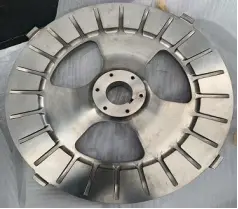
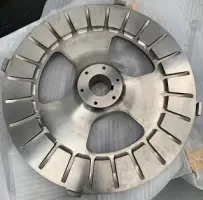
This type of titanium ring is used to be connected to certain shafts and then installed on some automated equipment or robots for stirring certain liquids, such as pulp. Therefore, it can be also named the core components of paper machine equipment.
II. Features:
|
GB/T |
Chemical Composition |
ASTM |
JIS |
|
TA1 |
|
Grade 1 |
TP270 |
|
TA2 |
|
Grade 2 |
TP340 |
|
TA3 |
|
Grade 3 |
TP450 |
|
TA4 |
|
Grade 4 |
TP550 |
|
TC4 |
Ti-6AI-4V |
Grade 5 |
TAP6400 |
|
TA10 |
Ti-0.3Mo-0.8Ni |
Grade 12 |
|
|
TA18 |
Ti-3AI-2.5V |
Grade 9 |
TAP3250 |
III. Technical parameters:
|
Nominal Component |
Type |
Heat Treatment Status |
Tensile Strength |
Elongation |
Cold bending Angle |
|
Industrial Pure Titanium |
TA2 |
Annealing |
340-490 |
≥30% |
≥130 |
|
Titanium alloy |
TC4 |
Annealing |
480~860 |
≥30%
|
≥130 |
IV. Advantages:
1. Exceptional corrosion resistance, withstanding complex pulp erosion: This product is manufactured from pure titanium or titanium alloy forgings. The titanium surface naturally forms a dense oxide layer that effectively blocks erosion from pulp and chemical media. Compared to traditional materials like stainless steel and cast iron, its resistance to pitting corrosion, crevice corrosion, and stress corrosion is enhanced by over 80%. This prevents issues such as chemical pulp contamination and equipment downtime caused by component corrosion, significantly extending maintenance intervals.
2. High strength and lightweight design reduce operational energy consumption:
Forging processes create a denser internal grain structure in titanium, eliminating casting defects. This achieves tensile strengths of 500-700 MPa for titanium rings, with yield strengths superior to comparable metals.
3. Exceptional wear resistance and fatigue endurance enable high-load operation.
V. Application fields:
Titanium rings are a type of machined titanium component. Leveraging the various advantages of titanium, they are widely used in the petroleum, chemical, aerospace, and deep-sea industries.