- English
- French
- German
- Portuguese
- Spanish
- Russian
- Japanese
- Korean
- Arabic
- Greek
- German
- Turkish
- Italian
- Danish
- Romanian
- Indonesian
- Czech
- Afrikaans
- Swedish
- Polish
- Basque
- Catalan
- China
- Taiwan China
- Esperanto
- Hindi
- Lao
- Albanian
- Amharic
- Armenian
- Azerbaijani
- Belarusian
- Bengali
- Bosnian
- Bulgarian
- Cebuano
- Chichewa
- Corsican
- Croatian
- Dutch
- Estonian
- Filipino
- Finnish
- Frisian
- Galician
- Georgian
- Gujarati
- Haitian
- Hausa
- Hawaiian
- Hebrew
- Hmong
- Hungarian
- Icelandic
- Igbo
- Javanese
- Kannada
- Kazakh
- Khmer
- Kurdish
- Kyrgyz
- Latin
- Latvian
- Lithuanian
- Luxembou..
- Macedonian
- Malagasy
- Malay
- Malayalam
- Maltese
- Maori
- Marathi
- Mongolian
- Burmese
- Nepali
- Norwegian
- Pashto
- Persian
- Punjabi
- Serbian
- Sesotho
- Sinhala
- Slovak
- Slovenian
- Somali
- Samoan
- Scots Gaelic
- Shona
- Sindhi
- Sundanese
- Swahili
- Tajik
- Tamil
- Telugu
- Thai
- Ukrainian
- Urdu
- Uzbek
- Vietnamese
- Welsh
- Xhosa
- Yiddish
- Yoruba
- Zulu
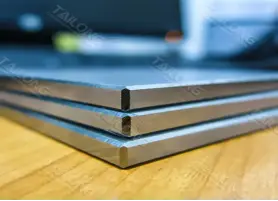
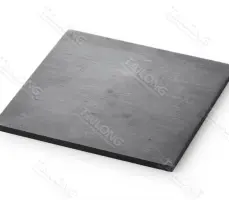
Titanium-steel composite plate
Standard :ASTM B898 / ASME SB-898 / GB/T 8547 / GB/T 26492
Plate Size:1000 mm × 6000 mm (Customizable)
Cladding Thickness:1.0 mm – 10.0 mm
Base Thickness:3.0 mm – 50.0 mm
Titanium-steel composite plate
Titanium-steel composite plate is a composite material formed by bonding a layer of corrosion-resistant titanium (clad layer) to a thicker stainless or carbon steel base (base layer) through processes like explosive welding, roll bonding, or hot-rolling lamination.
I. Introduction:
Titanium-steel composite plate is a novel metallic material formed by bonding titanium or titanium alloy as the cladding layer to carbon steel or low-alloy steel as the substrate through specialized processes. It combines titanium's exceptional corrosion resistance with steel's high structural strength while significantly reducing the cost of pure titanium materials, making it indispensable across multiple heavy industrial sectors.
II. Structure and Composition of Titanium-steel composite Plate:
The core construction of titanium-steel composite plates is a layered metallurgical bond structure of “facing layer (titanium/titanium alloy) + substrate (carbon steel/low-alloy steel).” A transition layer may be added in certain applications. The entire structure is bonded without adhesives, achieving atomic-level bonding through specialized processes. The structural design focuses on “functional zoning and complementary properties.”
III. Mainstream Preparation Processes:
1. Explosive Bonding Method: This widely adopted industrial technique employs explosive charges to generate shock waves traveling thousands of meters per second. Under instantaneous high temperature and pressure, titanium and steel plates undergo plastic deformation while removing surface oxides and gases, achieving cold metallurgical bonding. This process produces thick plates that can be hot-rolled to 4mm thickness, making the resulting sheets suitable for chemical equipment applications.
2. Thick Plate Rolling Method: Titanium and steel plates are assembled as an embedded billet with suitable intermediate inserts. They undergo electron beam welding under high vacuum, followed by heating and forced rolling to target thickness using a thick plate mill. The final product is cut and separated. Plates produced by this method serve as corrosion-resistant structural materials, such as tube sheets in power plant condensers.
3. Continuous Hot Rolling Method: Similar to the thick plate rolling method, but steel plates are inserted between the layers. Arc welding is performed under atmospheric conditions, followed by rolling through a continuous hot rolling mill to produce thin plates in coil form. These thin plates are primarily used in marine civil engineering applications, such as linings for offshore steel structures.
IV. Mechanical Properties Parameters:
|
Items |
Typical Requirements |
Test Standard |
|
Bonding Strength |
Shear strength ≥130MPa; Peel strength ≥12N/mm |
ASTM B898, GB/T 6396 |
|
Tensile Strength |
Non-design strength section: Complies with base material standards (e.g., Q235, ≥410MPa) |
GB/T 228.1, ASTM E8 |
|
Bending Performance |
Inward bend: 180° (mandrel diameter ≥2× total composite plate thickness) |
GB/T 232, ASTM E290 |
|
Outward bend: 105° (mandrel diameter = 3× total composite plate thickness) |
||
|
No delamination or cracks in bend zone |
||
|
Interface bonding |
Class 0: Bond area ≥100% (only ≤25mm detonation point defects allowed) |
Visual Inspection + UT(GB/T 8547) |
|
Class 1: Bond area ≥98% |
||
|
Class 2: Bond area ≥95% |
||
|
Flatness |
Thickness ≤30mm: Class 0/1 ≤8mm/m; Class 2 ≤15mm/m |
Measuring Tools (e.g., ruler) |
|
Thickness > 30mm: Class 0/1 ≤ 6mm/m; Class 2 ≤ 15mm/m |
||
|
Thickness Tolerance |
Composite: ±10% (≤±1.0mm) |
Ultrasonic thickness measurement |
|
Substrate: Corresponding standard deviation minus 0.5mm |
||
|
Total tolerance: Sum of composite + substrate tolerances |
V. Core Advantages
1. Exceptional corrosion resistance: The titanium layer withstands harsh media like acids, alkalis, and seawater, making it suitable for demanding environments in chemical processing and marine applications.
2. Cost-effective: Using steel as the substrate reduces overall costs while avoiding the high expenses associated with pure titanium materials.
3. Balanced mechanical properties: The steel substrate ensures structural strength and rigidity, meeting requirements for pressure-bearing and load-bearing structures.
4. Wide applicability: Replaces pure titanium plates in vessels, heat exchangers, pipelines, and other equipment, balancing performance and economy.
VI. Application Fields: Petrochemical, energy and power, marine and military sectors, plus emerging industries. In these domains, titanium-steel composite plates play an indispensable role by reducing costs while extending equipment lifespan.
1. Petrochemical Sector: TA1/Q345R titanium-steel composite plates used in oil pipelines exhibit over 25 years of H₂S corrosion resistance, reducing full-cycle costs by 40%.
2. Energy and Power Sector: Replacing glass flake linings in desulfurization towers with TA2/SA516Gr.70 titanium-steel composite plates extends maintenance cycles from 3 to 10 years;
3. Marine and Military: The pressure hull of Type 093 nuclear submarines, constructed with titanium-steel composite plates, achieves a 30% weight reduction while enabling magnetic stealth and enhanced navigation performance.
4. Emerging Sectors: Explosion-proof walls in lithium battery workshops using TA1/304 titanium-steel composite plates with graphene additives increased impact absorption capacity by 40%, achieving 3.2 times the energy absorption value of traditional materials and meeting explosion-proof safety requirements.
VII. Development Significance and Prospects:
The successful development of titanium-steel composite plates not only propels industry advancement but also represents a technological breakthrough. It is both a product of industry evolution and an inevitable requirement of application fields.
VIII.OEM Services
We offer customized solutions tailored to your industry’s needs. Our team provides expert consultation, material selection guidance, and precision processing to deliver made-to-order titanium steel plates with the highest quality standards.
IX.Frequently Asked Questions (FAQs)
1. What is the difference between titanium steel and regular steel?
Titanium steel offers a higher strength-to-weight ratio, better corrosion resistance, and improved heat resistance compared to traditional steel.
2. Can I order customized sizes?
Yes, we provide customized dimensions to fit your specific application requirements.
3. How long does shipping take?
Delivery times depend on order quantity and location, but we ensure timely and reliable shipping.
4. Do you provide certification for your materials?
Yes, all our products come with international standard certifications for quality assurance.